Java has been a top programming language for nearly 30 years. Companies use it for banking systems, e-commerce platforms, Android apps, and enterprise software. If you’re considering a career in Java development, you’re looking at a stable field with strong demand and clear progression paths.
This guide covers what to expect at each career stage, the skills you need to advance, and how to position yourself for higher roles and better compensation.
Career Stages Overview
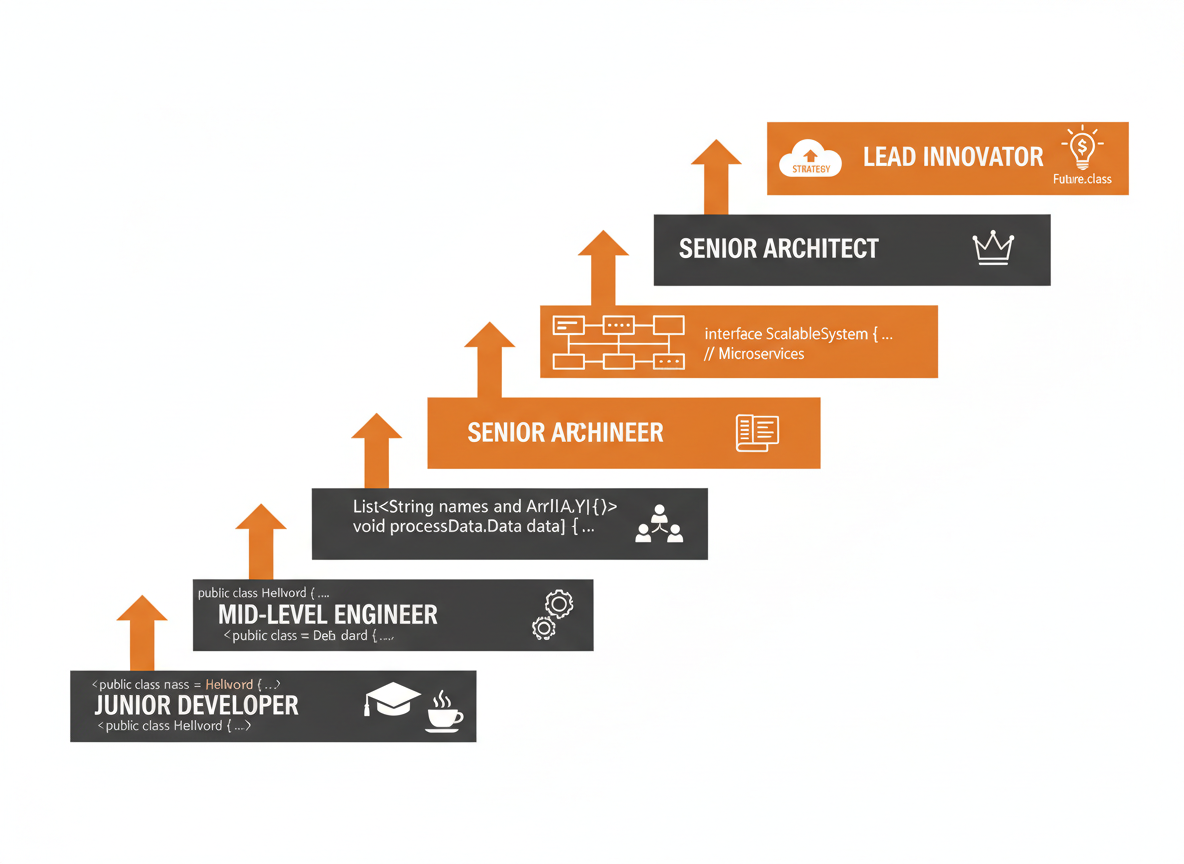
| Level | Experience | Salary Range (US, 2025) | Key Focus |
|---|---|---|---|
| Junior Developer | 0-2 years | $60,000 – $85,000 | Learning fundamentals, completing assigned tasks |
| Mid-Level Developer | 2-5 years | $85,000 – $120,000 | Independent work, feature ownership |
| Senior Developer | 5-8 years | $120,000 – $160,000 | Technical leadership, mentoring |
| Staff/Principal Engineer | 8+ years | $160,000 – $220,000+ | Architecture, cross-team impact |
| Engineering Manager | 6+ years | $150,000 – $200,000+ | People management, delivery |
Salaries vary significantly by location, company size, and industry. Tech hubs like San Francisco, New York, and Seattle pay higher. Remote roles have compressed some of these differences.
Junior Java Developer (0-2 Years)
What You’ll Do
As a junior developer, you’ll work on well-defined tasks under guidance from senior team members. Expect to:
- Fix bugs and implement small features
- Write unit tests for existing code
- Participate in code reviews (receiving feedback)
- Learn the codebase and team processes
- Ask questions and seek mentorship
Skills to Develop
Core Java fundamentals: OOP principles, collections, exception handling, file I/O, basic multithreading. You should be comfortable writing classes, using ArrayList and HashMap, and handling exceptions properly.
Build tools: Maven or Gradle for dependency management and builds. Know how to add dependencies and run tests.
Version control: Git basics including branching, merging, pull requests, and resolving conflicts.
Testing: JUnit for unit tests. Understand what makes a good test and aim for meaningful coverage.
SQL basics: Simple queries, joins, basic database concepts. You don’t need to be a DBA, but you should understand how data is stored and retrieved.
One framework: Usually Spring Boot for web applications. Know how to create REST endpoints, connect to a database, and handle basic configuration.
How to Get Your First Job
Entry-level Java positions are competitive. Here’s what helps:
Build projects: Create 2-3 substantial projects that demonstrate your skills. A REST API with database persistence, a command-line application, or a simple web app. Push them to GitHub with clean README files.
Contribute to open source: Even small contributions show initiative. Fix documentation, add tests, or tackle “good first issue” labels.
Practice coding problems: LeetCode, HackerRank, and similar platforms. Many interviews include algorithmic challenges, especially at larger companies.
Get certified (optional): Oracle Certified Professional Java SE certification can help your resume stand out, but it’s not required.
Apply broadly: Junior roles are hard to get. Apply to 50+ positions. Smaller companies and non-tech industries often have less competition.
Mid-Level Java Developer (2-5 Years)
What Changes
You’re no longer closely supervised. You take ownership of features from requirements to deployment. You start influencing technical decisions within your team.
Expectations include:
- Completing features independently with minimal guidance
- Reviewing code from junior developers
- Identifying and fixing issues before they’re assigned
- Participating in design discussions
- Improving existing code and processes
Skills to Develop
Advanced Java features: Streams API, lambdas, Optional, records, pattern matching. Modern Java code uses these extensively.
Spring ecosystem depth: Spring Security for authentication, Spring Data for database access, Spring Cloud for microservices. Understanding dependency injection and how Spring works under the hood.
Database expertise: Query optimization, indexing, transactions, connection pooling. Experience with PostgreSQL, MySQL, or Oracle. Possibly NoSQL databases like MongoDB or Redis.
Testing sophistication: Integration tests, mocking with Mockito, test containers, test-driven development practices.
API design: RESTful principles, API versioning, documentation with OpenAPI/Swagger.
Observability: Logging best practices, application monitoring, basic profiling. Tools like SLF4J, Logback, Prometheus, Grafana.
Containers: Docker for development and deployment. Basic Kubernetes concepts.
Career Growth Tips
Seek challenging work: Volunteer for complex features, legacy code refactoring, or performance optimization. Growth comes from struggle.
Document your impact: Keep track of what you’ve built, improved, and fixed. Quantify where possible: “Reduced API response time by 40%” or “Migrated 2 million records to new schema.”
Build relationships: Work with product managers, QA, and operations. Understanding the full development lifecycle makes you more effective.
Start mentoring: Helping junior developers teaches you more than you expect and demonstrates leadership potential.
Senior Java Developer (5-8 Years)
What Changes
You’re now a technical leader. You make architectural decisions, unblock other developers, and take responsibility for significant parts of the system.
Expectations include:
- Designing systems and components from scratch
- Leading technical projects across sprints or quarters
- Mentoring mid-level and junior developers
- Conducting thorough code reviews with constructive feedback
- Collaborating with architects and engineering managers
- Influencing team technical standards and practices
Skills to Develop
System design: Designing scalable, maintainable systems. Understanding trade-offs between different approaches. Familiarity with microservices vs monoliths, event-driven architecture, CQRS, and domain-driven design.
Performance engineering: Profiling applications, identifying bottlenecks, JVM tuning, garbage collection optimization. Tools like JProfiler, VisualVM, or async-profiler.
Security: OWASP top 10, secure coding practices, authentication and authorization patterns, vulnerability assessment.
Cloud platforms: Deep experience with AWS, Azure, or GCP. Services like EC2, RDS, S3, Lambda, or their equivalents.
Communication: Writing technical proposals, presenting to stakeholders, explaining complex topics simply. This skill often determines promotion to staff level.
Estimation and planning: Breaking down projects, identifying risks, providing accurate timelines.
Career Growth Tips
Develop a specialty: Become the go-to person for something valuable: performance, security, a specific framework, or a domain area. Specialists often command higher compensation.
Think beyond code: Consider business impact, user experience, operational costs. The best senior developers understand why they’re building something, not just how.
Build your reputation: Write blog posts, speak at meetups, contribute to technical communities. This opens doors and demonstrates expertise.
Decide your path: At this point, you’ll choose between continuing on the technical track (staff engineer) or moving to management. Both are valid, and neither is superior.
Staff/Principal Engineer (8+ Years)
What This Looks Like
Staff and principal engineers operate at the organizational level. You’re solving problems that span multiple teams, setting technical direction, and influencing company-wide decisions.
Expectations include:
- Defining technical strategy and architecture standards
- Leading initiatives that affect multiple teams or the entire organization
- Evaluating and recommending new technologies
- Resolving complex technical disagreements
- Representing engineering in executive discussions
- Growing other senior engineers
How to Get There
These roles are rare and competitive. What distinguishes staff engineers:
Demonstrated impact at scale: You’ve led projects that made a significant difference to the business. Migration of critical systems, major performance improvements, new platforms that enabled growth.
Technical breadth and depth: You understand the full stack and can go deep on specific areas. You’re comfortable discussing database internals, network protocols, or distributed systems.
Influence without authority: You get things done across teams without being anyone’s manager. People seek your input and follow your recommendations.
Strong communication: You write compelling technical documents, present clearly to executives, and facilitate productive technical discussions.
Engineering Manager Path
What This Looks Like
Engineering managers focus on people and delivery rather than writing code daily. You’re responsible for your team’s performance, growth, and wellbeing.
Responsibilities include:
- Hiring and building your team
- One-on-one meetings and career development
- Performance reviews and feedback
- Sprint planning and delivery management
- Removing blockers and shielding the team
- Coordinating with other managers and stakeholders
Is Management Right for You?
Management isn’t a promotion from senior developer. It’s a different job. Consider it if you:
- Genuinely enjoy helping others grow
- Find organizational problems interesting
- Are willing to step back from hands-on coding
- Can handle difficult conversations and decisions
- Want to multiply your impact through others
Don’t pursue management if you primarily want a higher salary or title. Many companies now offer staff engineer tracks with compensation equal to or exceeding management.
Alternative Paths
Solutions Architect
Architects focus on system design, often working with clients or across projects. Strong communication skills and broad technical knowledge are essential. Salaries range from $140,000 to $200,000+.
Technical Consultant
Consultants work with multiple clients on implementation, optimization, or strategy. Variety is high, but travel and project uncertainty are common. Rates range from $100 to $250+ per hour.
Developer Advocate
Developer advocates represent a company to the developer community through documentation, talks, tutorials, and support. Strong communication and genuine enthusiasm for helping developers are key. Salaries range from $100,000 to $180,000.
Independent Contractor
Experienced Java developers can work independently at higher hourly rates ($75-$200+) with more flexibility. Building a reputation and finding clients takes time, but many prefer the autonomy.
Industries Hiring Java Developers
Financial services: Banks, investment firms, insurance companies. Java dominates trading systems, risk management, and core banking. High pay, but demanding environments.
E-commerce: Retail platforms, payment processing, logistics. High scale, interesting optimization challenges.
Healthcare: Electronic health records, clinical systems, health tech startups. Growing demand with regulatory complexity.
Enterprise software: Companies building B2B products. SAP, Salesforce, Oracle, and countless others use Java extensively.
Technology companies: Google, Amazon, Netflix, LinkedIn all use Java significantly. High pay and strong engineering cultures.
Skills That Accelerate Your Career
Beyond core Java skills, these capabilities consistently correlate with faster advancement:
Strong communication: Clear writing, effective presentations, and the ability to explain technical concepts to non-technical people. This skill matters more as you advance.
Business understanding: Knowing why something matters, not just how to build it. Understanding revenue, costs, and user needs.
Reliability: Consistently delivering what you commit to. Following through on tasks. Being someone others can count on.
Initiative: Identifying problems before they’re assigned. Proposing improvements. Not waiting to be told what to do.
Learning agility: Picking up new technologies, frameworks, and domains quickly. The Java ecosystem evolves constantly.
Common Career Mistakes
Staying too long in one role: Comfort becomes stagnation. If you’re not learning, you’re falling behind. Consider moving after 2-3 years if growth has stopped.
Only focusing on technical skills: Soft skills often determine who gets promoted. Communication, collaboration, and leadership matter increasingly at higher levels.
Not negotiating: Especially at job offers. Companies expect negotiation. Research market rates and ask for what you’re worth.
Ignoring your network: Most senior roles come through referrals. Stay connected with former colleagues, attend meetups, and maintain your LinkedIn presence.
Avoiding difficult work: Legacy code, production incidents, and complex integrations are where you learn fastest. Don’t only pursue greenfield projects.
Getting Started
If you’re beginning your Java journey:
- Master the fundamentals: Complete the core curriculum on this site. Understand OOP, collections, exceptions, and file I/O thoroughly.
- Learn Spring Boot: It’s the most common framework for Java web development. Build a REST API project with database persistence.
- Practice coding problems: Spend 30 minutes daily on algorithm challenges. This prepares you for technical interviews.
- Build public projects: Create applications that demonstrate your skills. Document them well on GitHub.
- Apply consistently: Job hunting is a numbers game at the entry level. Expect many rejections before landing your first role.
Summary
Java development offers a stable career with clear progression. The path from junior to senior is well-established. Beyond senior, you choose between technical leadership (staff/principal) or people leadership (management).
Success requires more than coding skill. Communication, business understanding, and initiative distinguish developers who advance quickly from those who plateau.
The best time to start was years ago. The second best time is now.
Related: How to Prepare for a Java Technical Interview | 10 Java Interview Questions | Best Free Resources to Learn Java
Sources
- PayScale. “Java Developer Salary.” payscale.com
- Glassdoor. “Java Developer Salaries.” glassdoor.com
- Stack Overflow. “Developer Survey 2024.” stackoverflow.com/survey
- LinkedIn. “Jobs on the Rise 2024.” linkedin.com