Java turned 30 in 2025. In tech years, that’s ancient. New languages keep appearing: Go, Rust, Kotlin, TypeScript. So is Java still worth learning, or are you investing in a dying technology?
The short answer: Java remains one of the most valuable languages to learn. Here’s why, along with an honest look at where Java falls short.
The Numbers Tell the Story
Let’s start with data rather than opinions.
Job Market
Java consistently ranks among the top languages in job postings. As of late 2024:
- Indeed shows 80,000+ Java developer jobs in the US
- LinkedIn lists Java as a top 5 most in-demand programming skill
- Stack Overflow’s 2024 survey shows Java used by 30% of professional developers
Compare that to newer languages like Rust (under 15,000 US jobs) or Go (around 25,000). Java has roughly 3-5x more job opportunities than most alternatives.
Industry Usage
Java powers critical systems at:
- Finance: Goldman Sachs, JP Morgan, most major banks
- E-commerce: Amazon, eBay, Alibaba
- Tech: Google, Netflix, LinkedIn, Uber, Airbnb
- Enterprise: Most Fortune 500 companies
Android development, while shifting toward Kotlin, still requires Java knowledge. The Android SDK is written in Java, and millions of existing apps use it.
TIOBE and Language Rankings
Java has held a top 3 position on the TIOBE index for over two decades. It briefly dropped behind Python in recent years but remains solidly in the top tier. Languages don’t hold these positions by accident.
Why Java Persists
Enterprise Entrenchment
Large organizations have invested billions in Java systems. Rewriting those systems in another language would cost millions and take years. It’s simply not happening. These systems need maintenance, updates, and new features. That means Java jobs.
Banks are particularly conservative. A trading system that handles billions of dollars daily isn’t getting rewritten because a newer language has better syntax. Java’s stability is a feature, not a bug, for these organizations.
The JVM Ecosystem
Java isn’t just a language. It’s an ecosystem built on the Java Virtual Machine. That ecosystem includes:
- Spring Boot: The dominant framework for building web services
- Apache Kafka: The standard for event streaming
- Hadoop and Spark: Big data processing foundations
- Elasticsearch: Search and analytics
- Android: Billions of devices
Learning Java gives you access to this entire ecosystem. And because Kotlin, Scala, and other JVM languages interoperate with Java, your Java knowledge transfers to them.
Continuous Improvement
Java hasn’t stood still. Recent versions added:
- Records for concise data classes
- Pattern matching for cleaner conditional logic
- Text blocks for multi-line strings
- Virtual threads for simplified concurrency
- Improved switch expressions
Oracle releases new Java versions every six months. The language evolves while maintaining backward compatibility. Code written 20 years ago still runs on modern JVMs.
Performance
Modern Java is fast. The JVM’s Just-In-Time compiler produces highly optimized machine code. For long-running server applications, Java often matches or exceeds the performance of compiled languages.
Projects like GraalVM enable ahead-of-time compilation for faster startup, making Java competitive even for serverless and containerized deployments where startup time matters.
Where Java Falls Short
Let’s be honest about Java’s weaknesses.
Verbosity
Java code is verbose compared to Python, Kotlin, or TypeScript. A simple data class requires more boilerplate, even with recent improvements like records. This affects developer productivity, especially for small projects or scripts.
// Java
public record Person(String name, int age) {}

// Still more verbose than Python
# Python
@dataclass
class Person:
    name: str
    age: int
Slow Innovation
Java’s commitment to backward compatibility means new features arrive slowly. Pattern matching, available in other languages for years, only recently came to Java. If you want cutting-edge language features, Java isn’t where you’ll find them first.
Not Ideal for Every Domain
Java isn’t the best choice for:
- Quick scripts: Python is faster to write and run
- Frontend web: JavaScript/TypeScript dominate
- Systems programming: Rust and C++ provide more control
- Data science: Python’s ecosystem is stronger
- iOS development: Swift is required
Perception Problem
Some developers view Java as “boring” or “legacy.” Startups often choose Go, Node.js, or Python for their perceived modernity. This perception can affect which companies use Java for new projects, though enterprise adoption remains strong.
Who Should Learn Java
Learn Java If You Want:
Maximum job opportunities: More Java jobs exist than for any single alternative language. Your skills will be in demand.
Enterprise career: Banks, insurance companies, large corporations rely on Java. If you want to work at established companies with stable employment, Java opens doors.
Backend development: Java with Spring Boot is a dominant choice for building web services and APIs.
Android development: Even with Kotlin’s rise, Java knowledge remains valuable for Android. Many existing apps and tutorials use Java.
Big data: The Hadoop/Spark ecosystem is JVM-based. Data engineering roles often require Java or Scala.
Long-term career stability: Java has been relevant for 30 years and shows no signs of disappearing. Your investment will pay off for decades.
Consider Other Languages If:
You want frontend development: Learn JavaScript/TypeScript instead. Java runs on servers, not in browsers.
You’re focused on AI/ML: Python dominates machine learning. Java has ML libraries, but the ecosystem is smaller.
You want iOS apps: Swift is required for native iOS development.
You prefer cutting-edge features: Languages like Rust, Go, or Kotlin adopt modern features faster.
Java vs Alternatives for 2026
Java vs Python
Python is easier to learn and better for data science, scripting, and ML. Java is better for large-scale backend systems and enterprise applications. Many developers learn both.
Java vs JavaScript/TypeScript
JavaScript is required for frontend development. TypeScript adds type safety. Java is better for backend services. Full-stack developers often know JavaScript plus Java or Python.
Java vs Go
Go offers simpler syntax and excellent concurrency. Java has a larger ecosystem and more job opportunities. Go is growing in cloud infrastructure; Java dominates enterprise applications.
Java vs Kotlin
Kotlin runs on the JVM and is more concise than Java. It’s preferred for new Android development. However, Java knowledge helps you understand Kotlin, and many jobs still use Java directly.
Java vs C#
C# and Java are similar in capability. C# dominates the Microsoft ecosystem and game development (Unity). Java is stronger in cross-platform enterprise applications. Your choice may depend on which ecosystem you prefer.
The Learning Path Investment
Learning Java takes 3-6 months to become productive, longer to master. Is that investment worthwhile?
Return on investment: Java developers earn $70,000-180,000+ depending on experience and location. Few career paths offer similar earning potential for a similar time investment.
Transferable skills: Java teaches object-oriented programming, static typing, enterprise patterns, and JVM concepts that transfer to Kotlin, Scala, and other languages.
Career longevity: A Java developer who started in 2000 is still employable in 2026. The same can’t be said for every technology choice.
What the Future Looks Like
Predictions are risky, but some trends seem clear:
Java will remain relevant for enterprise: The installed base is too large to disappear. Companies will maintain and extend existing systems.
Spring Boot will continue dominating: It’s the default choice for Java web services, and nothing is positioned to replace it.
Kotlin will grow but not replace Java: Android development shifts toward Kotlin, but Java remains for backend systems and maintaining existing code.
Cloud-native Java improves: Projects like Quarkus and GraalVM make Java competitive for containerized and serverless deployments.
AI/ML won’t shift to Java: Python’s lead in machine learning is too strong. Java will integrate with ML systems but won’t become the primary ML language.
Getting Started
If you’ve decided Java is worth learning:
- Start with fundamentals: Work through the core curriculum on this site. Master OOP, collections, and exception handling before jumping to frameworks.
- Build projects: Theory only takes you so far. Build a calculator, a to-do app, then a REST API.
- Learn Spring Boot: It’s the gateway to professional Java development. Most job listings mention it.
- Practice coding problems: Technical interviews include algorithmic challenges. Spend time on LeetCode or HackerRank.
- Apply for jobs: Entry-level positions are competitive. Apply broadly and don’t wait until you feel “ready.”
Summary
Is Java worth learning in 2026? Yes, with conditions.
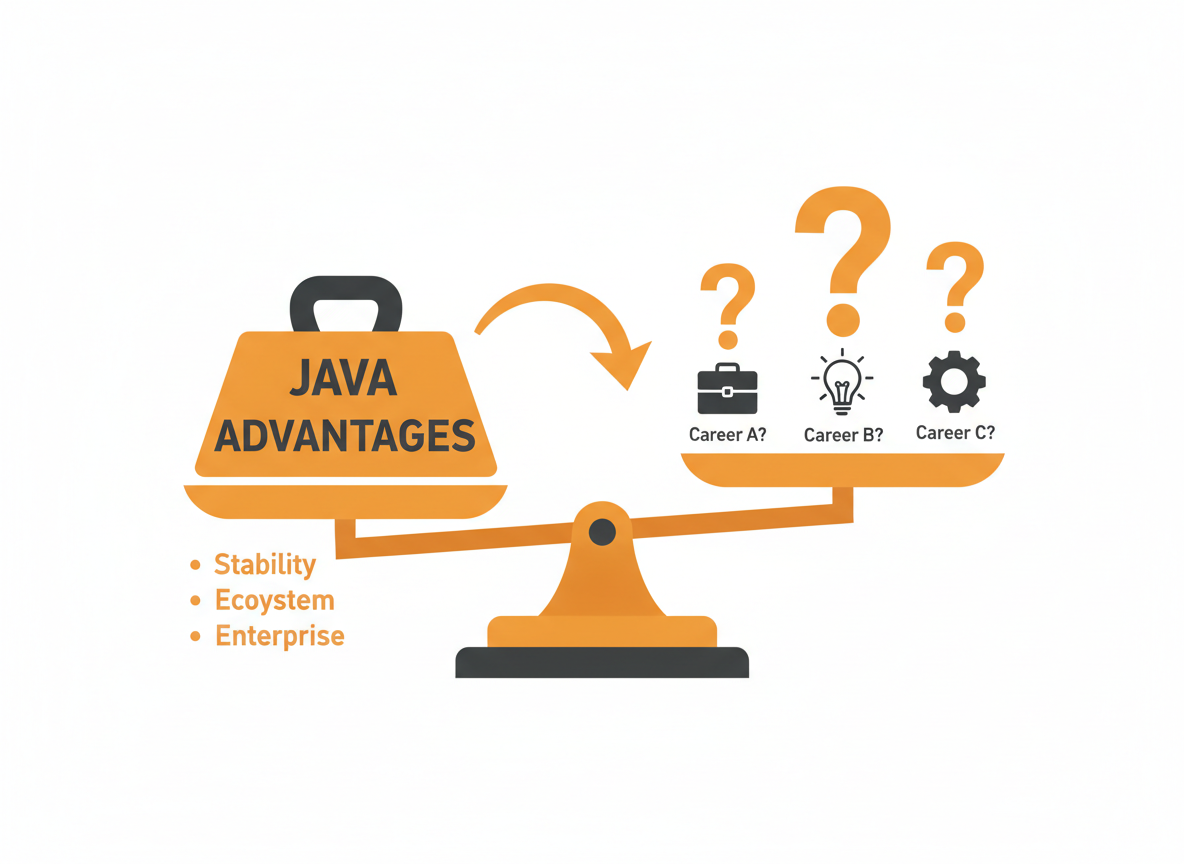
Yes if you want enterprise employment, backend development, Android apps, or maximum job opportunities. Java offers stability, strong salaries, and decades of continued relevance.
Maybe not if you’re focused on frontend development, data science, or want the newest language features. Other languages serve those needs better.
For most aspiring developers, Java remains one of the best investments you can make. The language is mature, the ecosystem is vast, and the job market is strong. Those fundamentals haven’t changed despite Java’s age, and they’re unlikely to change soon.
Related: Java Developer Career Path | Java Developer Salary Guide | What is Java? A Beginner’s Guide | Java vs Python
Sources
- TIOBE Index. “Programming Language Rankings.” tiobe.com/tiobe-index (accessed January 2025)
- Stack Overflow. “Developer Survey 2024.” stackoverflow.com/survey
- Indeed. “Java Developer Jobs.” indeed.com (accessed January 2025)
- LinkedIn. “Most In-Demand Skills 2024.” linkedin.com